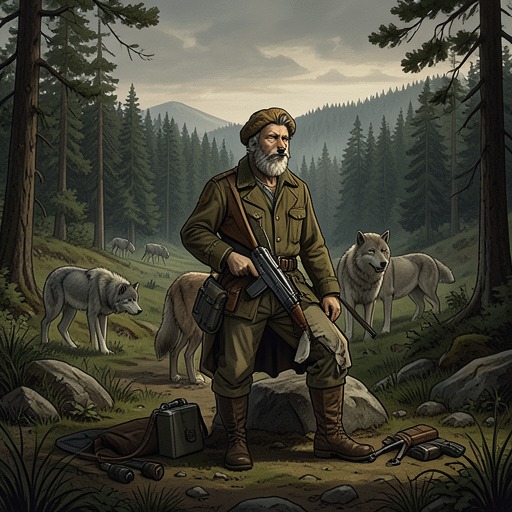
Wolf Reproduction and Population-Limiting Mechanisms
Never Cry WolfWolf Reproduction and Population-Limiting Mechanisms is the account’s explanation of why Keewatin Barren Lands wolves do not increase without limit: access to territory restricts who can breed, litter size varies with food and population conditions, and disease can sharply reduce numbers when ecological balance fails. Rather than treating population size as the product of uncontrolled multiplication, the book presents it as shaped by family life and the carrying capacity of the country, while also drawing attention to human actions that disturb that balance.
Territory, Maturity, and Family Life
The account, based on information from Ootek, describes breeding as conditional on both age and a place to establish a family. Females do not breed until they are two years old and males until they are three. Before reaching breeding age, many young adults remain with their parents; maturity alone does not guarantee that they can start a family. Suitable hunting territories are limited, and a territory must provide enough food to support a litter. If too many animals bred beyond what the country could sustain, prey numbers would decline and the wolves themselves would face starvation. Mature adults may therefore remain without mates for years while waiting for a place to become available.
The observed family groups give this constraint a social dimension. The book reports groups ranging from a pair of adults with three pups to seven adults with ten pups; extra adults were present in nearly every group encountered. The narrator initially struggled to make sense of a third adult in the family he watched, later known to him as Uncle Albert. Ootek’s explanation makes such nonbreeding adults part of the family’s organization rather than evidence of a population growing without restraint: their companionship and involvement with pups can continue even when they have no breeding territory of their own.
Ootek also described a long-lived male who had fathered a litter annually for six years. After his mate disappeared, possibly killed by bounty hunters, he remained at the old den. A litter was raised there the next spring by another pair, perhaps his son and daughter-in-law, while the older male continued to help provide for the pups. In this account, a family role can outlast a breeding partnership: the animal remained part of the household and its work without fathering the later litter.
Breeding Season and Litter Size
The period of intense mating appetite is described as lasting only about three weeks in a year. The book uses this short season to qualify the apparent hardship of adults that remain without mates: the account suggests that they may not experience prolonged sexual deprivation, while the family group offers companionship and participation in raising young. Ootek believed that some adults might even prefer an aunt or uncle role, with the pleasures of helping to rear pups but not the full responsibilities of parenthood. This interpretation makes communal care part of the population mechanism, not merely a by-product of it.
The number of pups in a litter is also presented as responsive to conditions. When food species are plentiful, or the wolf population is sparse, a female may have as many as eight pups. When animals are numerous or food is scarce, litters may fall to one or two. The account thus links reproductive output to the resources available, rather than depicting each breeding female as producing the same number of young regardless of circumstance. Territorial limits and litter-size variation work at different points in the same process: one restricts how many adults can establish families, while the other changes how many pups those families raise.
Ecological Checks and Disease
Disease is described as an overriding check that can act when other restraints fail. If the population becomes too abundant for the available prey, often after human interference has upset the balance, food shortage weakens the animals. The account says that malnutrition may progress to starvation and that outbreaks of rabies, distemper, or mange can then reduce numbers to a surviving remnant. Disease is therefore not presented as a routine substitute for territorial and reproductive limits, but as a severe correction associated with exceptional imbalance.
The 1946 example shows how several pressures could coincide. Lemmings, whose numbers in the Canadian Arctic rise and fall in a four-year cycle, were then near the low point. At the same time, depleted Caribou herds changed their longstanding migration pattern and largely bypassed southern central Keewatin. The resulting scarcity affected people, Foxes, and the wolves; rabies, already latent among hungry Foxes, spread to wolves as well. In the book’s explanation, the outbreak belongs to a chain of ecological conditions, not to an inherent tendency toward aggression or unchecked growth.
Observation and Interpretation
The account distinguishes field observation from conclusions about population dynamics. The narrator describes watching the animals at a distance through a telescope and keeping a timed log; on one morning he recorded a leading male reaching a marked boundary at 0814. Ootek’s knowledge supplies interpretations that the narrator could not derive from a single sighting, including the ages at which animals breed and the role of adults who help raise pups. The resulting explanation combines repeated observation with local knowledge, while making clear that some claims about the family’s organization are reported judgments rather than directly measurable facts.
Observations of hunting also place reproductive limits within a food system. In hunts the narrator watched, groups of as many as eight animals moved among Caribou and often abandoned a pursuit when the deer ran strongly and appeared in good condition. These scenes support the account’s emphasis on constraints: food is not simply an unlimited supply, and successful hunting is not assured. The reproductive argument depends on that wider premise that family numbers must remain tied to what the animals can obtain.
Human Pressures and the Population Argument
The book sets natural population checks against human pressures on both predators and prey. Mike told the narrator that he killed roughly two or three hundred Caribou, perhaps more, in a year to feed his fourteen dogs, himself, and his trapping operation. The narrator knew of 1,800 trappers in parts of the winter range and calculated a possible annual total of 112,000 Caribou killed after halving both the number of trappers and Mike’s reported kill for his estimate. He presents that figure as a cautious extrapolation, not as an independently verified count; its significance is the contrast between the trappers’ survey responses, which minimized their own kills, and their attribution of large-scale losses to wolves.
The account also describes direct, organized pressure on the wolf population. Governments offered bounties of ten to thirty dollars per animal, and one trapper collected bounty on 118 wolves in a winter, 107 of them young. Rather than relying only on trapping or shooting, the trapper used strychnine over a wide area, a method the book says also killed Foxes, wolverines, and other flesh-eaters. Separately, the book reports a proposed Minnesota plan to destroy 200 wolves each year and a Quebec contest announced in late 1972 with a target of 5,000. These examples complicate any account that explains wildlife decline solely through wolf numbers: the population mechanisms described here operate amid deliberate killing and human changes to the prey base. The governing point is not that natural regulation makes the animals invulnerable, but that their reproduction and survival are constrained by ecological conditions even as human intervention can impose a further, drastic pressure.